Aquatics Envirothon Study Materials
Aquatics Study Areas
Water Budget • Local Water Budgets • The Hydrologic Cycle • The Water Molecule • Watersheds & Delineation • Competing Uses of Water • Water Pollution • Wetlands • Pond/Lake Ecosystems • Riparian Areas • Laws Protecting Water • Stream Assessment • Acid Rain • Drinking Water • Stream Order • Source Water • Aquatic Invertebrates • Stormwater • Water Math • Aquifers • Aquatics Sample Test
COMPETING USES OF WATER
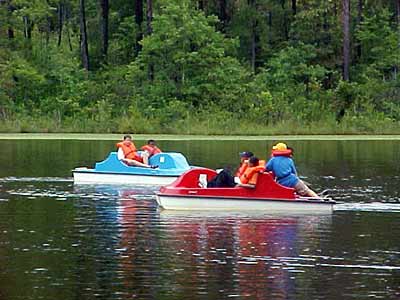
"Good water years" - years when rainfall is plentiful - make accommodating everyone's needs and desires for water much easier. During periods of drought, however, just meeting minimal needs can be very difficult.
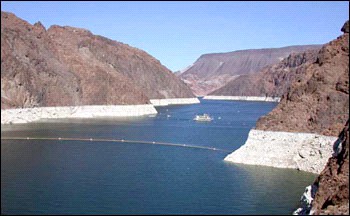
The thick white band ringing Lake Mead's shoreline shows the drop in water levels.
The near-vertical walls of Boulder Canyon are just upstream of Hoover Dam.
(Photograph courtesy National Park Service)
Because competing users want the water for their own purposes, finding ways to share the resource is becoming an ever-increasing challenge for managers.
It is critical that Federal, State, and local agencies, as well as other water user interest groups find ways to accommodate each user's needs, whenever possible, and still meet the needs of the users. Water managers hope that this can be accomplished through various means.
- Educate the public on water conservation.
- Distribute water conservation literature.
- Develop a Drought Contingency Plan. It will need to be implemented and enforced.
- Get the stakeholders together to discuss the issue.
- Consider buying water from another source.
- Determine emergency sources of water and secure all the necessary agreements, rights-of-way, and easements, required to gain access to the source.
- Implement water reduction measures on all the users.
- Call for voluntary conservation.
- Ask home users to install household water conservation devices.
- Accelerate public education programs.
- Start saving rainwater.
- Develop water reuse and greywater recycling.
- Incorporate mandatory nonessential water use bans.
- Ration water.
- Increase the efficiency of the existing distribution system through leakage and loss reduction programs.
- Ask commercial and industrial customers to use their own emergency sources (if they have them).
- Prioritize the competing uses.
- The ski resort will need to reduce or eliminate the amount of snowmaking once the season changes.
- Switch to low water use crops.
- Limit irrigation.
IMPACTS OF COMPETING USES
Often, the aquatic ecosystem is changed because of competing uses. Sometimes to a series of negative impacts can occur because of the societal needs for water. One of the major things that could happen is hydrologic modification. This is where a stream or river is altered because of human activity. All hydrologic modifications, whether properly or improperly implemented, may result in water pollution, which will impact aquatic and riparian habitats.
Population growth and development may cause land use changes that result in hydrologic changes to watersheds. Channel modifications are sometimes needed to maintain navigable waterways and control flooding. Dam construction and operation is often necessary to store water for irrigation, recreation, and flood control and to provide a source of drinking water. Yet, these activities can be sources of pollution and adversely affect water quality and habitat if not properly managed.
One of the principal pollutants resulting from hydrologic modification is sediment. Excess nutrients and toxics may also be associated with sediment produced by hydrologic modification activities. These activities also may disturb riparian areas causing an increase in streambank erosion, and destruction of aquatic habitat.
Stream channels are often modified to straighten, relocate or change their depth and width. Once this is done, that will change:
- the instream water temperature
- the physical and chemical characteristics of the bottom sediment
- the rate of transport and sediment deposition, and
- more than likely there will be increased flooding downstream
Constructing dams and impoundments can result in significant changes in the ecology of streams. Naturally, there will be an increase of sediment and chemical contaminants. The dam operation itself will produce changes in the water temperature and chemistry (pH and dissolved oxygen). Dams and impoundments may also disrupt the natural transportation of sediment and can result in significant changes to instream flow.
The effects of flow alterations include blockage of fish migrations; alteration and loss of stream habitat; introduction of competing non-native fishes; degradation of water quality; alteration of nutrient cycles; disruption of food webs; destruction of fish eggs; decreased fish abundance, size, and condition; increased hybridization of closely related fishes competing for spawning sites; and decreased nutrient availability.
Unless streamflows are established, implemented, and protected, the following impacts can be expected to accelerate:
- Replacement of unique regional fauna by fishes adapted to more regulated stream environments. This would result in more listings of endangered species. Stream fishes currently considered as endangered would disappear in nature.
- Localized stream flooding will continue to degrade bottomlands, reduce stream productivity, and adversely affect stream fishes.
- Riparian habitat will continue to be degraded, adversely affecting stream quality.
- Reductions of streamflows will reduce and degrade stream habitat, increase summer water temperatures, reduce oxygen, and concentrate pollutants.
- Fluctuating flows associated with power generation will reduce stream resources by promoting unstable channels. Such flows will alternately scour, then promote downstream siltation of stream habitats.